Most exercise programs train individual muscles. The body doesn't move that way. When you walk, run, throw, or change direction, force travels across long, continuous chains of tissue that span multiple joints — connecting a muscle on one side of the body to a muscle on the other. These are the myofascial slings. Understanding them changes how you train, and often explains why isolated strengthening produces incomplete results.
There is a second idea here that most people have not met before, and it is worth knowing before you decide whether this is for you. Training a sling is not the same kind of training as building a muscle. A chain's job is to pass force along its length at speed — the give-and-return that happens when you throw, swing a tool, sprint, or lift something awkward off the floor. That is a problem of timing and coordination between muscles, not of how large any one of them is.
It also has to be trained at the right end of the force–velocity relationship. Rotational power is twisting force multiplied by twisting speed, and the two trade off against each other: if one is high, the other has to be low. Heavy, slow twisting under load is the demanding end of that trade-off. Light and fast is the end where a chain can be asked to do the thing it is actually for — carrying energy across the trunk from one side of the body to the other.
That is why the progressions in this course run stretch, then traditional load, then dynamic load, and why the dynamic work is deliberately light and quick. It is not hypertrophy training. It is coordination, timing and efficiency work — the aim being a chain that behaves as one connected unit rather than as a row of separate muscles.
This course introduces all four slings — their anatomy, their mechanical role, and a practical exercise sequence for each. Equipment required: a resistance band and a kettlebell or dumbbell.
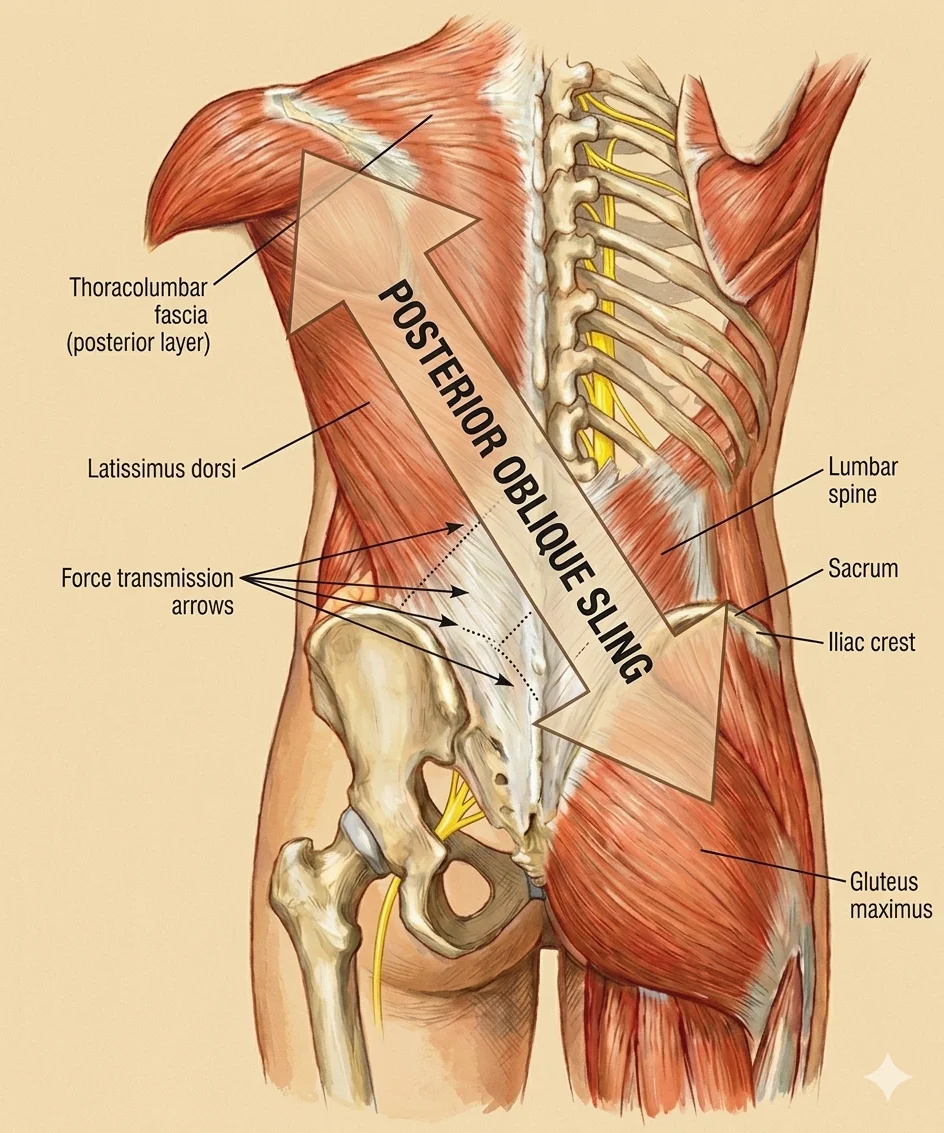
Course Modules
Who This Course Is For
This course is designed for anyone who wants to train smarter rather than just harder — people who have found that isolated strengthening doesn't translate to better movement, or who are recovering from a musculoskeletal problem and want to understand how the body actually transfers load. It assumes some familiarity with basic gym exercises but no clinical background.
It is not a substitute for individual assessment. If you have current pain or injury, an assessment is the right starting point — this course is designed as a complement to clinical care, not a replacement for it.
Please note: This course is for educational purposes only. Individual presentations vary. Please consult a registered health practitioner before beginning if you have current pain, recent injury, or post-surgical status.
Enrol — It’s Free
Five modules plus a course index, delivered through our online portal. Free, no card required, and yours to revisit whenever you like.
Already a patient or have a question? (03) 9787 0600 · Book Online
Or if you are ready to book an assessment: Book Online · (03) 9787 0600