 By Dr Steven Hewitt — Chiropractor · AHPRA: CHI0001115420 · 31 March 2026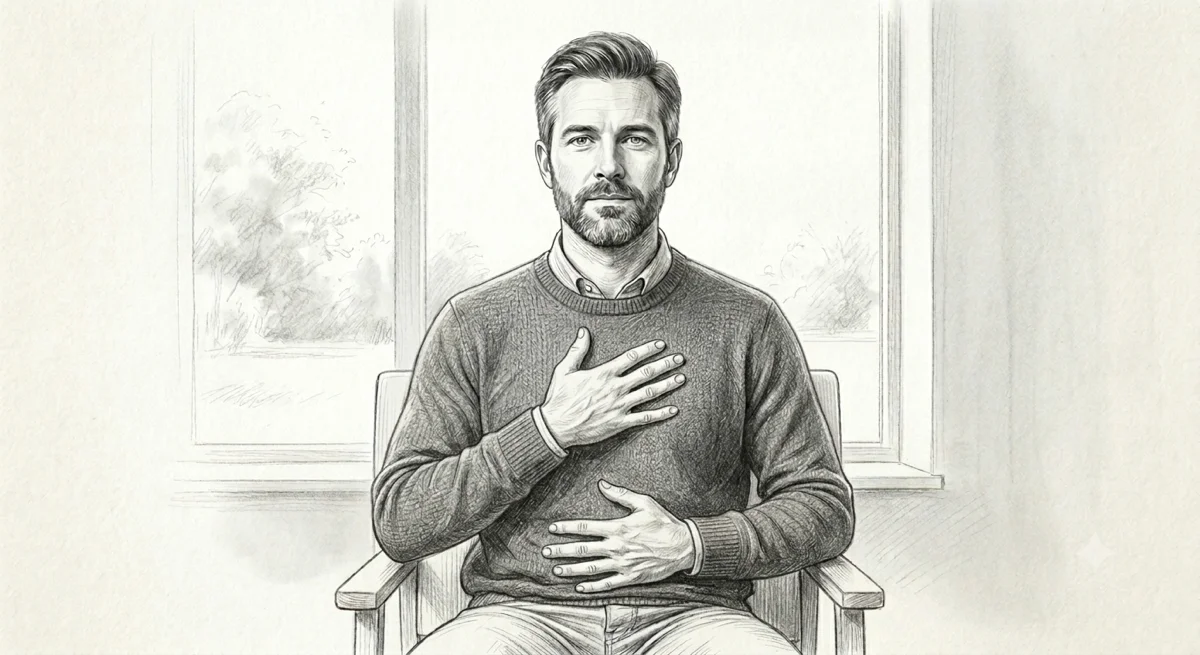
Category: Clinical Insights
Related conditions pages: Neck Pain | Shoulder | Low Back Pain
Free course: Free Breath Retraining Program
Most people who come in with neck pain, shoulder tension, or recurring back pain have tried stretching and strengthening. Many have had scans. Some have had repeated courses of treatment that helped for a while, then didn't hold. What almost none of them have had assessed is their breathing pattern — despite the fact that breathing mechanics directly influence the loading environment of the cervical spine, the thorax, the shoulder girdle, and the lumbar spine. This post explains why that connection exists and what the research now shows about it.
Context: The Diaphragm Is Not Just a Breathing Muscle
The diaphragm is the primary driver of respiration — it contracts on every inhale, descending into the abdominal cavity and expanding the thorax three-dimensionally. But it does considerably more than move air.
Kocjan and colleagues (2017) published a comprehensive review documenting the diaphragm's multifunctional role across the body. [1] Anatomically, the diaphragm is innervated by the phrenic nerve (roots C3–C5), which anastomoses with the vagus nerve along its pathway and makes contact with the spinal trigeminal nucleus — connecting the diaphragm neurologically to the same structures involved in headache, jaw pain, and autonomic regulation. Functionally, this muscle extends its influence from the trigeminal system down to the pelvic floor, acting as both a postural stabiliser and a pressure-regulation system for the thoracic and abdominal cavities.
The postural function is the one most relevant here. The diaphragm generates intra-abdominal pressure (IAP) with every breath, and this pressure is a primary mechanism of lumbar spine stabilisation. It works in coordinated timing with the transversus abdominis and the pelvic floor — the same deep stabiliser system that rehabilitation programmes for low back pain specifically target. When breathing pattern is compromised, this stabilising role is compromised simultaneously.
The consequence is predictable: when the diaphragm is not doing its full job, secondary respiratory muscles — the scalenes, upper trapezius, sternocleidomastoid, and levator scapulae — take on increased load. These are the same muscles that are almost universally tight in people presenting with neck pain. They are not overloaded because something is structurally wrong with them. They are overloaded because they are covering for a deeper system that is underperforming.
What the Research Shows
Forward head posture reduces lung function. Han and colleagues (2016) compared adults with clinically confirmed forward head posture (FHP) against adults with normal posture, measuring forced vital capacity (FVC), FEV₁, and accessory respiratory muscle activity via EMG. [2] FVC and FEV₁ were significantly lower in the FHP group. Accessory muscle activity — specifically the sternocleidomastoid and pectoralis major — was also lower, suggesting that FHP does not simply recruit these muscles more; it weakens their capacity for respiratory work, impairing both postural and respiratory function simultaneously.
The lower thorax — where diaphragmatic breathing actually occurs — is specifically restricted in FHP. Koseki and colleagues (2019) extended this work with a 3D thoracic shape analysis in healthy males breathing in forward versus neutral head positions. [3] Forward head posture produced upper thoracic expansion and lower thoracic contraction — the opposite of optimal diaphragmatic breathing mechanics, which requires lower thoracic mobility. Lower thoracic excursion during respiration was significantly reduced in the forward posture condition. Forced vital capacity, inspiratory reserve volume, FEV₁, and peak flow were all significantly lower. The mechanism is direct: FHP physically restricts the region of the thorax where the diaphragm operates.
Thoracic spine mechanics and respiratory function are bidirectional. Babina and colleagues (2016) conducted an RCT in 62 people with chronic non-specific low back pain, comparing standard LBP treatment plus breathing exercises against the same program with the addition of Maitland's central PA thoracic mobilisation (T1–T8). [4] Both groups improved, but the thoracic mobilisation group showed significantly greater improvements in FVC, sustained maximal inspiratory pressure, and chest wall expansion. This finding matters for clinical practice: the relationship between spinal mechanics and breathing is not one-directional. Treating the thorax improves breathing capacity; addressing breathing supports the spine.
Diaphragm training changes the deep lumbar stabiliser system. Finta and colleagues (2018) conducted an RCT in 52 people with chronic low back pain, comparing complex exercise with and without the addition of specific diaphragm training. [5] Ultrasound measured transversus abdominis and diaphragm thickness before and after the intervention. The diaphragm training group showed significant increases in transversus abdominis thickness in relaxed positions and diaphragm thickness in contraction — changes not seen in the control group. Targeting the diaphragm directly produces measurable morphological improvements in the deep stabiliser system that standard LBP programmes attempt to address through other means.
Adding diaphragm manual therapy and breathing re-education to cervical treatment produces superior outcomes. Tatsios and colleagues (2025) conducted an RCT in 90 patients with non-specific chronic neck pain, comparing three groups over 10 treatment sessions: cervical spine manual therapy plus diaphragm manual therapy plus breathing re-education; cervical manual therapy plus sham diaphragm technique; and conventional exercise therapy. [6] The group receiving diaphragm manual therapy and breathing re-education showed the largest overall improvement in cervical range of motion, with improvements maintained at three-month follow-up. The intervention that addressed respiratory mechanics produced more durable cervical outcomes than cervical treatment alone.
Why This Matters for Our Approach
The diaphragm sits at a central fascial junction. The thoracolumbar fascia, the mediastinal fascia, the pericardial fascia, and the respiratory diaphragm are structurally continuous — restriction anywhere in this system influences loading throughout it. This is the fascial lens applied to breathing: the way air moves through the body is inseparable from the way force moves through it.
Our assessments specifically include respiratory mechanics — not as an add-on, but as a routine component of evaluating why structures in the neck, shoulder, and low back are loaded the way they are. We are looking at whether the diaphragm is functioning as a stabiliser, whether thoracic mobility is sufficient to support diaphragmatic excursion, and whether the secondary respiratory muscles are carrying a chronic load that belongs elsewhere.
This is an area that is not always assessed in a standard consultation. It is, in our clinical experience, one of the reasons the same structures can keep recurring — the loading pattern that created the problem has not been fully addressed because one of its primary drivers has not been identified.
Relevant conditions pages: Neck Pain in Desk Workers | Cervicogenic Headache | Rotator Cuff Tendinopathy | Low Back Pain
What This Means for You
A simple self-assessment takes about thirty seconds. Place one hand flat on your sternum and one on your lower abdomen, just below the navel. Breathe normally, without trying to change anything. Which hand moves first and most? If the answer is the upper hand — the chest — you are breathing with a thoracic-dominant pattern. That is not unusual; it is extremely common in people who spend significant time seated. It is also addressable.
If you notice that your upper chest tightness, end-of-day neck fatigue, or afternoon headaches track consistently with periods of concentrated desk work or stress, there is a reasonable chance that a respiratory component is contributing — alongside the postural one. The two are rarely separate.
If you want to start working on this directly, the free Breath Retraining program walks through the fundamentals — diaphragmatic mechanics, nasal breathing, and paced breathing techniques — in a structured five-module format you can work through at home. Request your copy here.
If the pattern is well-established, symptoms are significant, or you want to understand specifically what is driving your presentation, a clinical assessment is the logical starting point. Breathing mechanics can be assessed directly, and a clinical picture of how the respiratory system is contributing to your MSK load is something that can be mapped clearly.
Ready to look at this more specifically?
Book Online — available 24/7
Free Breath Retraining Program — request your copy
Call Us — speak with our team
This is the first in a three-part series on breathing and health. The second post addresses the nervous system angle: CO₂, heart rate variability, and why the panic-breathing loop is more mechanical than most people realise.
References
- PubMed Kocjan J, Adamek M, Gzik-Zroska B, Czyżewski D, Rydel M (2017). Network of breathing. Multifunctional role of the diaphragm: a review. Advances in Respiratory Medicine, 85(4), 224–232.
- PubMed Han J, Park S, Kim Y, Choi Y, Lyu H (2016). Effects of forward head posture on forced vital capacity and respiratory muscles activity. Journal of Physical Therapy Science, 28(1), 128–131.
- PubMed Koseki T, Kakizaki F, Hayashi S (2019). Effect of forward head posture on thoracic shape and respiratory function. Journal of Physical Therapy Science, 31(1), 63–68.
- PubMed Babina R, Mohanty PP, Pattnaik M (2016). Effect of thoracic mobilization on respiratory parameters in chronic non-specific low back pain: a randomized controlled trial. Journal of Back and Musculoskeletal Rehabilitation, 29(3), 587–595.
- PubMed Finta R, Nagy E, Bender T (2018). The effect of diaphragm training on lumbar stabilizer muscles: a new concept for improving segmental stability in the case of low back pain. Journal of Pain Research, 11, 3031–3045.
- PubMed Tatsios PI, Grammatopoulou E, Dimitriadis Z, Koumantakis GA (2025). The effectiveness of manual therapy in the cervical spine and diaphragm, in combination with breathing re-education exercises, on the range of motion and forward head posture in patients with non-specific chronic neck pain: a randomized controlled trial. Healthcare, 13(14), 1765.
Please note: The information in this post is intended for educational purposes only and does not constitute clinical advice. Individual presentations vary significantly and this post is not a substitute for individual clinical assessment. If you have significant pain, arm symptoms, or symptoms that are worsening, please seek assessment from a registered health practitioner. Nothing in this post constitutes clinical advice for your individual situation.