Most lower back programs focus on the back itself — core exercises, stretches, and a list of movements to avoid. Some of that has value. But for many people, those programs provide temporary improvement and then the pain returns. The reason is that they address the symptom site without addressing the system that created it.
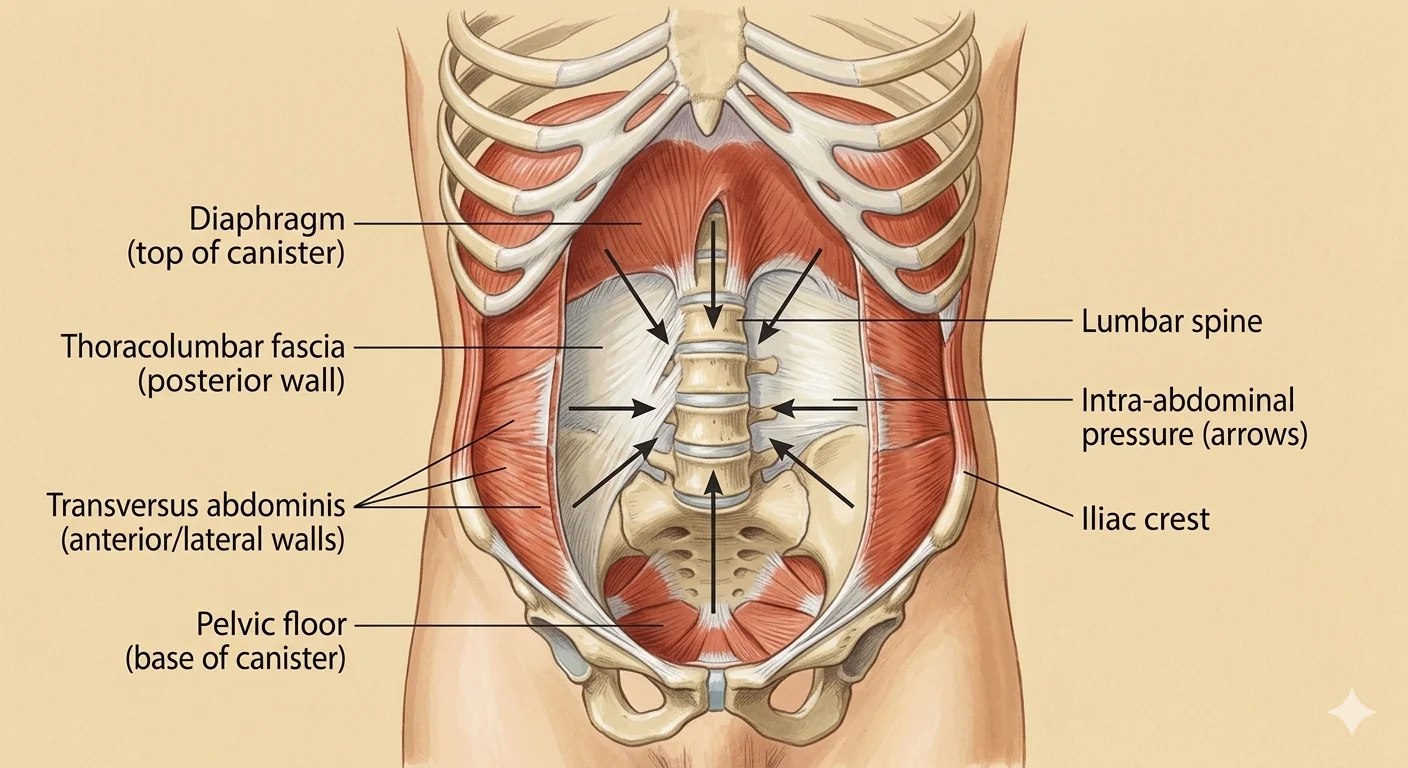
The lumbar spine is stabilised by a pressurised canister — the diaphragm above, the pelvic floor below, the abdominal wall at the front, and the thoracolumbar fascia at the back. When that system is poorly coordinated — as research consistently shows it is in people with chronic low back pain — the lumbar joints absorb load that should be distributed across the whole structure. This program starts there. Phase 1 rebuilds canister function from the inside out. Phase 2 progressively loads the diagonal slings that transfer force across the pelvis during real-world movement.
It won't replace individual assessment — every lower back presentation is different, and some need clinical input before beginning. But for people who want to understand the evidence and start rebuilding the right foundation, this is where to start.
What the Program Covers
Who This Program Is For
This program is suited to people with non-specific low back pain — pain without a clearly identified structural cause such as a disc herniation with nerve root compression, fracture, or inflammatory arthritis. It is particularly relevant for people with recurrent or persistent low back pain, desk workers with postural loading patterns, and active individuals with load-related back symptoms.
It is not designed for people with acute disc injuries with neurological signs, fractures, inflammatory conditions such as ankylosing spondylitis, or pain with red flag features. If you are unsure of your diagnosis, an assessment before beginning is the right starting point.
What You Will Need
- A mat or firm surface for floor exercises
- Approximately 15–20 minutes per session — each phase contains two exercises; the depth of instruction reflects their importance, not their simplicity
- No equipment required for either phase
Please note: This program is for educational and self-management purposes only. Individual presentations vary — your assessment and management should be tailored specifically to you. If your symptoms are severe, worsening, include neurological signs (leg weakness, bladder or bowel changes), or you are unsure of your diagnosis, please consult a registered health practitioner before beginning. Nothing in this program constitutes clinical advice for your individual situation.
Enrol — It’s Free
Enter your details below and we'll send you immediate access:
Already a patient or have a question? (03) 9787 0600 · Book Online