Knee assessment at Elevate Health Care covers the knee itself, the hip that controls it and the foot beneath it — because both change how load reaches the joint. Conditions commonly assessed include patellofemoral pain (runner's knee), patellar tendinopathy (jumper's knee) and ITB-related lateral knee pain. Treatment combines Fascial Manipulation by Stecco with movement rehabilitation and graded loading.
Is your knee pain actually coming from your hip?
Very often, yes — at least in part. The knee is a relatively simple hinge caught between two joints that rotate: the hip above and the foot below. It has limited ability to control the forces they pass through it.
When the hip abductors and rotators don't control the thigh well, the knee falls inward under load — running, landing, going down stairs, standing up from a chair. That changes how the kneecap is loaded against the groove it runs in, and it's one of the most consistent findings in people with pain around the front of the knee. From below, how the foot contacts the ground and how the ankle moves alters the same chain from the other end.
This is why treatment aimed only at the knee often gives short-lived relief, and why our assessment covers the hip and foot as a matter of routine rather than only when the knee looks normal.
→ Why knee pain is rarely just a knee problem — the full explanation, with references
→ Hip pain — if the hip itself is also painful, not just contributing
Runner's knee, jumper's knee, or something else?
Three presentations account for most of the knee pain we see, and they're told apart by where it hurts and what provokes it more reliably than by imaging.
- Around or behind the kneecap, worse going down stairs, sitting for long periods, squatting or running downhill — this pattern points to patellofemoral pain, often called runner's knee.
- A precise, tender point at the bottom tip of the kneecap, provoked by jumping, landing and deep squatting, classically warming up during activity and biting afterwards — this pattern points to patellar tendinopathy, or jumper's knee.
- Sharp pain on the outside of the knee, coming on at a fairly predictable distance into a run and easing with rest — this pattern points to ITB syndrome.
They're managed differently, which is why the distinction matters more than it might seem. Getting it wrong is a common reason a program doesn't work.
What we assess
- The knee itself — patella position and tracking, tendon tenderness, joint movement and swelling
- The hip — abductor and rotator control, and what the thigh does under single-leg load
- The foot and ankle — dorsiflexion range and how the foot contacts the ground
- The fascial system — densification through the fascia lata, ITB and surrounding tissue, using Fascial Manipulation by Stecco
- How you move under load — squatting, stepping down, single-leg control, and running mechanics where relevant
- Your load — training volume, recent changes, surfaces, footwear and what changed before the pain started
Knee conditions we commonly assess and treat
Patellofemoral Pain Syndrome (Runner's Knee)
Pain around or behind the kneecap — hip mechanics, quadriceps control and how the patella is loaded.
Learn more →Patellar Tendinopathy (Jumper's Knee)
Load-related pain at the bottom tip of the kneecap, and the evidence-informed loading approach.
Learn more →ITB Syndrome
Lateral knee pain in runners — the compression model and what actually works.
Learn more →When knee pain needs a different kind of assessment
Most knee pain is musculoskeletal and load-related. A few presentations need prompt medical or orthopaedic assessment rather than ours.
Seek urgent medical care if knee pain comes with:
- A hot, swollen, very painful joint with fever or feeling unwell — an infected joint needs same-day assessment
- Calf pain, swelling, warmth or redness — particularly after surgery, injury, immobilisation or long-haul travel
- A knee that locks and won't fully straighten, or that gave way with a pop at the time of injury and swelled rapidly
- Inability to bear weight after a significant injury, or obvious deformity
- Knee pain in a child or adolescent, particularly with a limp or reduced hip movement — hip conditions in this age group commonly present as knee pain, and this warrants prompt medical assessment
If you're unsure, call your GP or present to an emergency department. This page is general information, not advice about your situation.
Your first visit
A 60-minute initial consultation: history, physical assessment of the knee, hip and foot, an explanation of what we've found, and treatment starting the same visit where appropriate.
No referral is required. If imaging is needed, we'll arrange it. If someone else is better placed to help, we'll say so.
Not ready to book? Start with the free program
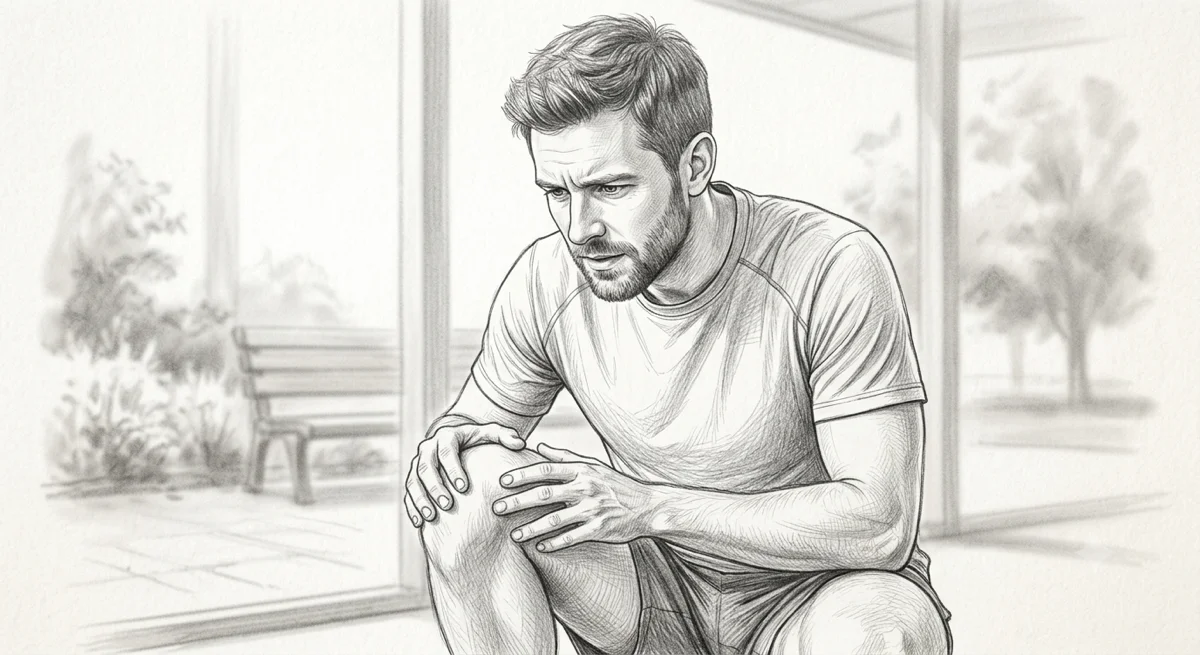
A structured two-week plan for jumper's knee — isometrics to settle the pain first, heavy slow resistance to rebuild capacity — and a clearer sense of whether you can manage it yourself or need an assessment.
It's built specifically around the patellar tendon, so it's the wrong starting point if your pain sits around the kneecap or on the outside of the knee. Use the patterns above to check which one you're dealing with first.
- What Patellar Tendinopathy Is
- Load Management & What to Avoid
- Phase 1 — Isometric Loading (Days 1–7)
- Phase 2 — Heavy Slow Resistance (Days 7–14)
- Return to Sport & the Long Game
Frequently Asked Questions
Please note: The information on this page describes our general clinical approach and is intended for educational purposes only. Individual presentations vary, and your assessment and management will be tailored specifically to you. Nothing on this page constitutes clinical advice for your individual situation. Please consult a registered health practitioner for advice about your specific condition.