Hip assessment at Elevate Health Care covers the hip itself, the lower back and pelvis above it, and the knee below — because both change how load reaches the joint and its tendons. Conditions commonly assessed include gluteal tendinopathy, femoroacetabular impingement syndrome and proximal hamstring tendinopathy. Treatment combines Fascial Manipulation by Stecco with movement rehabilitation and graded loading.
Is it really bursitis?
If you have pain on the outside of your hip, there's a good chance someone has called it trochanteric bursitis. For years that was the standard label, and the standard response was a cortisone injection into the bursa.
The evidence has moved. Imaging and surgical studies have repeatedly found that the bursa is often not the main problem — the culprit is usually the gluteal tendons where they attach to the bony point of the hip, irritated by compression against that bone rather than by inflammation in a sac beside it.
That changes what helps. Compression is increased by sitting with crossed legs, standing with your weight dropped onto one hip, sleeping on your side without support, and stretching that pulls the leg across the body — the very stretch many people are given for it. Tendons respond to graded loading, and to taking the compression off. A randomised trial comparing education plus exercise against injection found the exercise approach did better at twelve months — the injection's early advantage did not hold.
None of which means an injection is never appropriate. It means the label matters, because it decides what you do next.
→ Gluteal Tendinopathy — the compression model and the LEAP trial in full
→ The hip: why getting to the root requires more than imaging — the deep dive, with references
Where is your hip pain?
“Hip pain” covers several different problems, and where you feel it narrows things down faster than a scan does.
- On the outside, over the bony point — worse lying on that side, sitting cross-legged, or standing on one leg. This pattern points to gluteal tendinopathy.
- In the groin or deep in the front — worse with deep squatting, sitting low, or rotating the leg inward, sometimes with catching or clicking. This pattern points to FAI syndrome.
- Deep in the buttock or right at the sit bone — worse with prolonged sitting, driving, lunging or sprinting, and often described as a dull ache that bites when you stretch it. This pattern points to proximal hamstring tendinopathy.
- Across the buttock and into the thigh, varying with your back — this may not be a hip problem at all. The lower back and sacroiliac joint refer here readily. See lower back pain.
These overlap more than the list suggests, which is exactly why the assessment matters — but they're a far better starting point than a report describing changes that are common in people with no pain at all.
What we assess
- The hip joint — range, what provokes and what relieves, and how it behaves under single-leg load
- The gluteal tendons — tenderness, and the positions and habits that compress them through the day
- The lower back and pelvis — because both refer into the hip and change how it is loaded
- The knee and foot — the chain below, which alters what the hip has to control
- The fascial system — densification through the lateral hip, fascia lata and posterior chain, using Fascial Manipulation by Stecco
- Your load — training, sitting, sleep position, and what changed before the pain started
Hip conditions we commonly assess and treat
Gluteal Tendinopathy
Lateral hip pain driven by compression — the LEAP trial and what the evidence now recommends.
Learn more →Hip Impingement (FAI Syndrome)
Femoroacetabular impingement — the Warwick Agreement and a rational approach to management.
Learn more →Groin Pain
Adductor-related, inguinal and pubic causes — and what “sports hernia” and “athletic pubalgia” actually mean.
Learn more →Proximal Hamstring Tendinopathy
Deep gluteal and sit-bone pain — the 5-stage loading protocol.
Learn more →When hip pain needs a different kind of assessment
Most hip pain is musculoskeletal and load-related. A few presentations need prompt medical or orthopaedic assessment rather than ours.
Seek urgent medical care if hip pain comes with:
- Inability to bear weight after a fall, particularly in older adults or anyone with osteoporosis — a hip fracture needs same-day assessment even when the hip looks normal
- A hot, very painful hip with fever or feeling unwell — an infected joint is a medical emergency
- Deep groin pain that is worsening and unrelated to activity, particularly with a history of long-term steroid use or heavy alcohol intake
- Unexplained weight loss, night pain that is unrelenting, or a history of cancer
- Hip or knee pain with a limp in a child or adolescent — hip conditions in this age group can present at the knee and warrant prompt medical assessment
If you're unsure, call your GP or present to an emergency department. This page is general information, not advice about your situation.
Your first visit
A 60-minute initial consultation: history, physical assessment of the hip, lower back and knee, an explanation of what we've found, and treatment starting the same visit where appropriate.
No referral is required. If imaging is needed, we'll arrange it. If someone else is better placed to help, we'll say so.
Not ready to book? Start with the free program
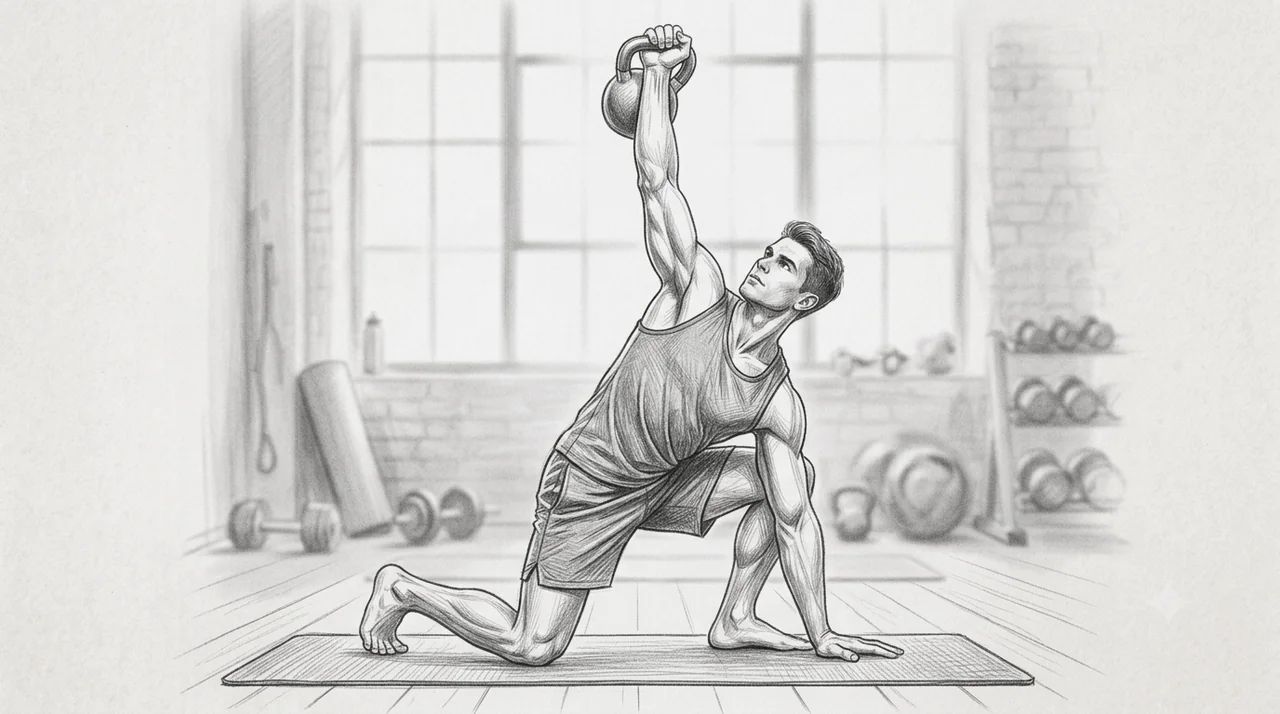
The four myofascial slings and a progressive stretch → strength → power sequence for each — closing with the Half Turkish Get-Up as a whole-body integrator.
It isn't a hip rehab protocol, and it won't tell you which structure is involved. But two of the four slings run straight through the hip, so if your hip gives way under single-leg load rather than simply hurting, it addresses the control that sits behind that.
- The Sling System — What It Is and Why It Matters
- The Deep Longitudinal Sling
- The Posterior Oblique Sling
- The Anterior Oblique Sling
- The Lateral Sling & Integration
Frequently Asked Questions
Please note: The information on this page describes our general clinical approach and is intended for educational purposes only. Individual presentations vary, and your assessment and management will be tailored specifically to you. Nothing on this page constitutes clinical advice for your individual situation. Please consult a registered health practitioner for advice about your specific condition.