Foot and ankle assessment at Elevate Health Care covers the foot itself, the ankle and calf above it, and the hip that controls the leg — because what the foot has to absorb is set further up. Conditions commonly assessed include plantar fasciopathy, Achilles tendinopathy, ankle sprain and chronic instability, and tibialis posterior tendinopathy. Treatment combines Fascial Manipulation by Stecco with graded loading.
It's probably not "fasciitis"
Heel pain is almost always labelled plantar fasciitis, and the "-itis" implies inflammation. When the tissue has actually been examined, what shows up in persistent cases is degenerative change — disorganised collagen and altered tissue quality — rather than an inflammatory process.
That matters because it changes what helps. If the problem were inflammation, anti-inflammatories and rest would resolve it, and for most people they don't. Tissue showing degenerative change needs graded loading to rebuild capacity, which is close to the opposite of rest.
It also explains the pattern people describe: better after a few minutes of walking, worse again later in the day, and back to square one after a weekend off. That isn't inflammation flaring — it's a tissue that has lost load tolerance.
→ Plantar Fasciopathy — why the name matters, and what the loading approach looks like
→ Why foot and ankle pain is never just a foot problem — the deep dive, with references
Where is your foot or ankle pain?
- Under the heel — sharpest on the first steps in the morning or after sitting, easing then returning with time on your feet. This points to plantar fasciopathy.
- Back of the heel or a few centimetres up the tendon — stiff to start, warms up with activity, aches afterwards. This points to Achilles tendinopathy.
- Inside of the ankle and along the arch — worse with standing and walking, sometimes with the arch flattening over time. This points to tibialis posterior tendinopathy.
- Outside of the ankle, with a history of rolling it — and a sense of it giving way on uneven ground. This points to ankle sprain and chronic instability.
These overlap, and more than one can be present at once — but where it hurts and what provokes it narrows things down faster than imaging usually does.
What we assess
- The foot — where it is tender, arch behaviour under load, and toe and forefoot mechanics
- The ankle — dorsiflexion range, stability, and how it behaves on one leg
- The calf — capacity and endurance, because it carries most of the load through push-off
- The hip — control of the leg above, which changes how the foot meets the ground
- The fascial system — densification through the plantar fascia, calf and posterior chain, using Fascial Manipulation by Stecco
- Your load — footwear, training volume and surfaces, standing hours at work, and what changed before it started
Foot & Ankle conditions we commonly assess and treat
Plantar Fasciopathy
Heel pain that bites on the first steps of the day — and why "fasciitis" is the wrong word for it.
Learn more →Achilles Tendinopathy
Tendon pain that warms up with activity and aches afterwards, and the loading that rebuilds it.
Learn more →Ankle Sprain & Chronic Instability
Why ankles keep rolling after the first sprain — proprioception, not just strength.
Learn more →Tibialis Posterior Tendinopathy
Inner-ankle and arch pain, and the tendon that supports the arch under load.
Learn more →When foot or ankle pain needs a different kind of assessment
Most foot and ankle pain is load-related. A few presentations need prompt medical assessment rather than ours.
Seek urgent medical care if you have:
- Sudden severe pain at the back of the ankle with a snapping sensation, and difficulty pushing off or standing on tiptoe — a ruptured Achilles tendon needs same-day assessment
- Inability to bear weight after an injury, or bony tenderness over the ankle bones following a twist or fall
- A hot, swollen, very painful joint with fever or feeling unwell
- Calf pain, swelling, warmth or redness — particularly after surgery, immobilisation or long-haul travel
- Numbness, colour change, or a foot that feels cold, or a wound that isn't healing — particularly with diabetes
If you're unsure, call your GP or present to an emergency department. This page is general information, not advice about your situation.
Your first visit
A 60-minute initial consultation: history, physical assessment of the foot, ankle, calf and hip, an explanation of what we've found, and treatment starting the same visit where appropriate.
No referral is required. If imaging is needed, we'll arrange it. If someone else is better placed to help, we'll say so.
Not ready to book? Start with the free program
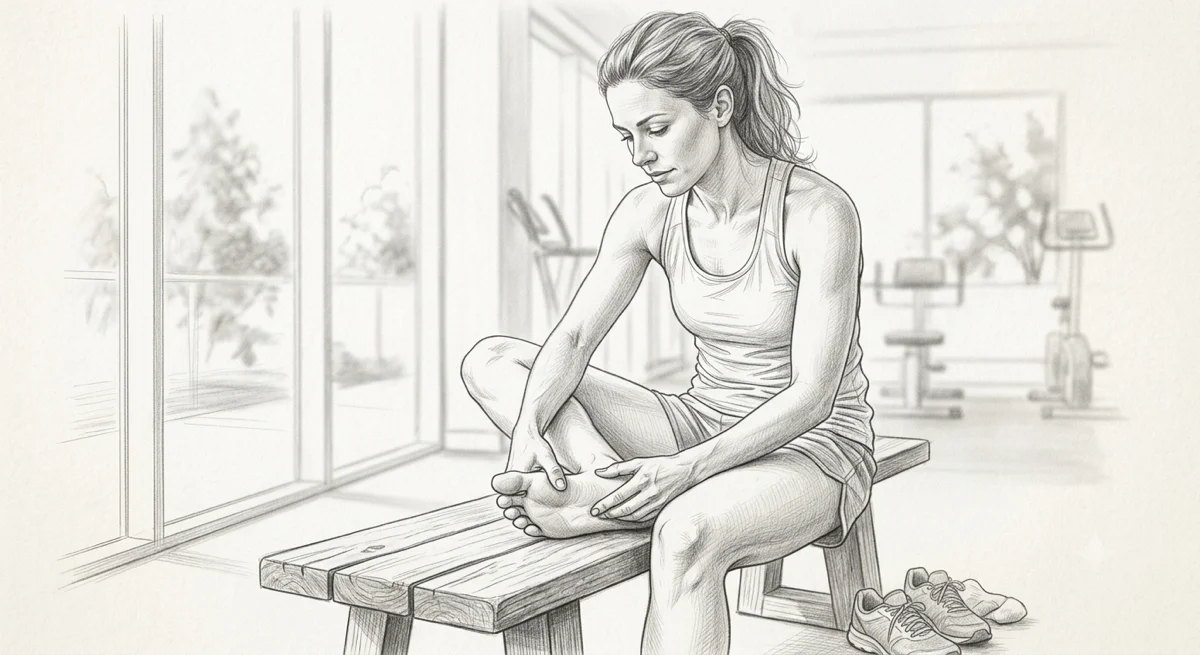
A structured two-week loading plan for stubborn heel pain — built on why the tissue behaves the way it does, not just a list of stretches.
It's built specifically around the plantar fascia, so it isn't the right starting point for Achilles pain or ankle instability. Use the patterns above to check which one you're dealing with first.
If you had a significant ankle sprain years ago and consider it long resolved, it is worth reading Fully Recovered, or Just Not Sore? — balance and fascial changes have been measured in people whose function scores read as normal.
- Why Most Treatment Falls Short
- Load Management & What to Avoid
- Phase 1 — Calf & Foot Exercises (Days 1–7)
- Phase 2 — Ankle & Posterior Chain (Days 7–14)
- Full Program Schedule & the Long Game
Frequently Asked Questions
Please note: The information on this page describes our general clinical approach and is intended for educational purposes only. Individual presentations vary, and your assessment and management will be tailored specifically to you. Nothing on this page constitutes clinical advice for your individual situation. Please consult a registered health practitioner for advice about your specific condition.