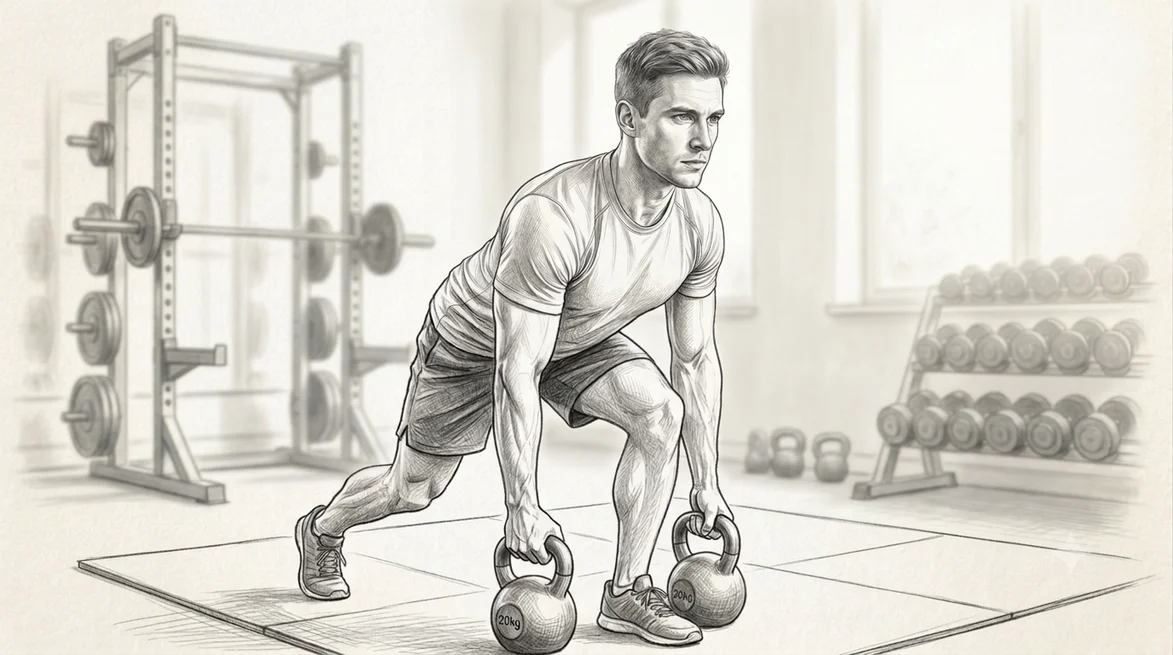
What we commonly see in athletes
Across lifters, footballers, runners and everyone in between, a few patterns come up far more often than the diagnoses would suggest.
The injury that resolves and then does not. Pain settles, function returns, and the athlete is cleared — but movement testing still shows a difference between sides years later. In one study of people a mean of four years after an ankle sprain, self-reported function averaged 97.6 out of 100 while balance testing and tissue assessment were still measurably altered. We wrote about that here.
The site of pain is not the site of the problem. A knee that hurts under load when the hip is not controlling its fair share of the load. A shoulder that complains when the thorax will not rotate. This is the ordinary case rather than the exception, and it is why we assess the chain rather than the sore part.
Load tolerance, not tissue damage. Tendon problems in particular sit on a continuum, and where a tendon sits on it changes what it can accept this week. Managing that is a different job from resting until it stops hurting.
Something changed before the pain did. A jump in training volume, a new programme, a surface change, a return from a break, a season starting. When Australian researchers interviewed the medical and fitness staff at all sixteen AFL clubs about one of the more stubborn presentations in the sport, every respondent described it as a load problem — and noted that simply reducing load is not the answer either, because the load is what the sport requires. That page is here.
The part that is not always assessed
A standard assessment tends to answer one question well: what is the painful structure? That is a necessary question and sometimes it is enough.
Where it tends to fall short in athletes is the next one — why that structure was overloaded. Force does not travel through isolated muscles. It travels through connected sheets of fascia and through coordinated systems that span joints, and when one part of that system stops contributing, something else takes the difference. Often for years, quietly, until it cannot.
That is the area we specifically assess: how load transfers, where it stops transferring, and what the tissue quality is like along the way. We view it through a fascial lens as well as a joint and muscle one, and we look at it under the movements the sport actually demands rather than on a table alone.
The sling system is where that gets explained properly — four coordinated systems that carry load diagonally and longitudinally through the body, and the reason your shoulder can influence your opposite hip, and vice versa.
What working with us looks like
The first visit is 60 minutes. Most of it is assessment, and a fair amount of that is watching you move under something resembling the demand you actually put on yourself.
- History that includes the programme — what changed, when, and by how much. Not just where it hurts.
- Assessment of the chain, not only the painful region, including how load transfers across the pelvis, thorax and shoulder girdle.
- Fascial Manipulation where the assessment points to it — a systematic method for finding and treating restricted points, which are frequently remote from the pain.
- Loading, not resting, wherever it is appropriate. Progressive, staged, and matched to what the tissue can currently accept.
- A plan you can train around, because in most cases stopping entirely is neither necessary nor useful.
- A referral when that is the right answer. Some presentations need imaging, a surgical opinion or a different practitioner, and we will tell you when.
Please note: The information on this page describes our general clinical approach and is intended for educational purposes only. Individual presentations vary, and your assessment and management will be tailored specifically to you. Nothing on this page constitutes clinical advice for your individual situation. Please consult a registered health practitioner for advice about your specific condition.
Why this practice in particular
Dr Steven Hewitt has been in practice for over 23 years, with a lifelong interest in exercise science. He competed at state level in Olympic weightlifting and has spent plenty of time on the gym floor since. It means the person assessing you understands what a snatch actually asks of a shoulder and a hip, and has spent years breaking movement patterns down — working out how one restriction changes the way somebody moves, and what the rest of the body starts doing to cover for it.
The clinical approach centres on Fascial Manipulation by Stecco and movement rehabilitation, with a deliberate emphasis on reading the research rather than repeating opinion. Every clinical claim on this site is linked to the paper behind it — the whole library is public.
Start here
If you already know roughly what you are dealing with, these are the pages worth your time.
The presentations we see most often in athletes
- Patellar tendinopathy — jumper's knee; warm-up pattern; why quad stretching can make it worse
- Rotator cuff tendinopathy — overhead load, compression, and scapular contribution
- Proximal hamstring tendinopathy — the deep sit-bone ache that hates sprinting and sitting equally
- Achilles tendinopathy and ankle sprain & chronic instability
- Groin pain — adductor-related, pubic-related, and what the older labels actually mean
- Lateral epicondylalgia — and why the cortisone shot wins at six weeks and loses at a year
The ideas worth reading
- Fully Recovered, or Just Not Sore? — what the research shows years after an injury has settled
- The myofascial slings — how load actually transfers, and why isolated strengthening misses it
- “Lazy glutes” is the wrong diagnosis — four different things that get called the same thing
Free programs you can start today
Each is five short modules, built from the same approach we use in clinic. No cost, no card.
- Sling Training — improving your load transfer capacity
- Patellar Tendinopathy · Rotator Cuff · Lateral Epicondylalgia · Plantar Fasciopathy · Lower Back Reset
Book an assessment
We are at Suite 30, Level 1, 93 Wells Road, Chelsea Heights — a short drive from Aspendale, Edithvale, Carrum, Patterson Lakes, Mordialloc and Seaford. No referral is required. Allow 60 minutes for a first visit.