Ready to get on top of this?
Call Now — speak with our team
Book Online — available 24/7
What Is Thoracic Outlet Syndrome?
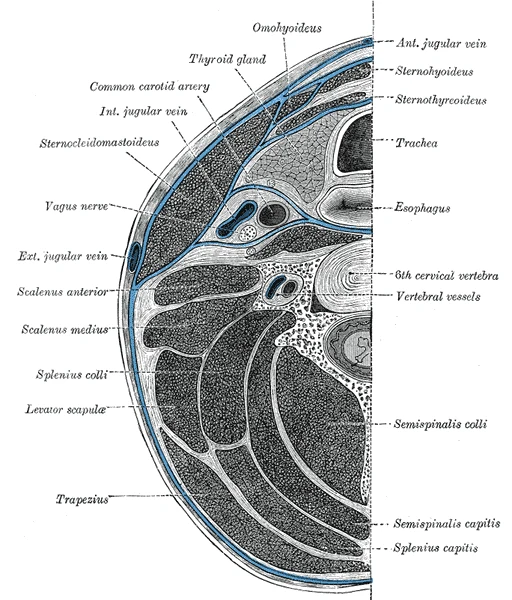
The nerves and blood vessels that supply the arm (the brachial plexus, subclavian artery and subclavian vein) leave the base of the neck, cross the first rib and pass under the collarbone and the pectoralis minor before reaching the armpit. Compression is described at three points along that route: the scalene triangle, between two neck muscles and the first rib; the costoclavicular space, between the collarbone and the first rib; and the space beneath the pectoralis minor, just below the front of the shoulder [1].
Not one condition, and two ways of classifying it
“Thoracic outlet syndrome” is an umbrella for several different problems, and the specialists who deal with it don’t agree on how to divide them up.
Neurophysiologists, who test nerve function, recognise five types. Four have a clear structural cause, consistent features and a test that identifies them. The fifth, by far the largest group, has none of those, and is called disputed TOS. In that framework, “many experts doubt its existence altogether”, and it is “better considered a cervicoscapular pain syndrome”, a pain syndrome of the neck and shoulder region [2, 3].
The Society for Vascular Surgery takes the opposite view. It defines neurogenic TOS clinically, from symptoms and examination findings, and states that the labels “true” and “disputed” are “unhelpful and should not be used” [4].
Neither framework is settled. The practical point is that most people given this diagnosis have arm symptoms with normal nerve tests. That is the group the surgeons call neurogenic TOS and the neurophysiologists call disputed TOS, and it is the group conservative care is for.
| Type | What is involved | How common | What it looks like | What it needs |
|---|---|---|---|---|
| Venous TOS | Subclavian vein | About 0.5–1 per 100,000 people a year; roughly one in six TOS referrals [5] | Swelling of the whole arm, a dusky or bluish colour, heaviness and prominent veins; often follows strenuous, repetitive arm use [3] | Urgent medical assessment |
| Arterial TOS | Subclavian artery | Sporadic; about 2% of referrals [5] | A cold, pale or painful hand, colour change, arm fatigue with use; most often associated with a cervical rib [3] | Urgent medical assessment |
| True neurogenic TOS | The lower brachial plexus, usually compressed by a fibrous band at the base of the neck [2] | Rare: about one person in a million [2] | Gradually worsening hand weakness and clumsiness, with visible wasting of the muscles at the base of the thumb [2] | Referral for nerve conduction testing |
| Neurogenic TOS (surgical definition) or disputed TOS (neurophysiological definition) | Uncertain; no consistent structural finding [3] | The large majority of referrals; about 2–3 per 100,000 people a year [5] | Pain, aching or pins and needles in the neck, shoulder, arm and hand, often worse with the arms overhead or hanging, often in both arms, with a normal neurological examination [3, 4] | Rule out other causes first; conservative care is the usual first step [3] |
A fifth, less common type follows a fracture of the collarbone and is managed medically [3].
You may read that thoracic outlet syndrome affects as many as 8 in every 100 people. The study that set out to measure it traced the commonly repeated “3 to 80 per 1,000” back through a chain of citations to a source that gives no source, and called it “a number essentially created out of thin air that has taken on a life of its own based on repeated citation” [5]. Its own estimate comes from every referral to one specialist centre over nearly four years. It rests on the authors’ assumptions about how many local cases reached them, so it is an estimate rather than a count [5].
Who Typically Experiences This?
Adults with arm symptoms on one or both sides
The largest group, disputed TOS in the neurophysiological framework, is adult-onset and more common in women. Unlike the other types, it frequently affects both arms [3].
People whose symptoms began after a neck injury
Among specialists who study the disputed form, trauma is the most commonly proposed trigger. It can be a single event, most often a whiplash injury, or repeated strain, and in one series it was the underlying cause in 91% [3]. That is a proposed mechanism rather than an established one, but a previous neck injury is always worth mentioning at an assessment.
People who work or train with their arms overhead
Postural position and repetitive movements such as throwing, weightlifting and manual labour are recognised as bringing on symptoms [6].
People whose symptoms follow their posture through the day
Desk workers, drivers and people who carry heavy bags on one shoulder often notice symptoms building through the day. The best-known conservative rehabilitation model for TOS was written for people in whom posture appears to contribute substantially, and it centres on how the shoulder blade rests and moves [7].
People who have been told they have a cervical rib
An extra rib at the base of the neck is found in roughly 0.5–2% of people. True neurogenic TOS affects about one person in a million, so at most one in 5,000 people with a cervical rib develops it. When a cervical rib turns up during investigation of non-specific arm symptoms, it “most likely is incidental” [2]. It becomes more relevant when there is hand muscle wasting or a circulation problem, which is when it is investigated further.
The Fascial Lens: Why We See This Differently
Three passages bounded by soft tissue
Each of the three sites is bounded largely by muscle and fascia, not bone alone. The scalenes sit within the deep layers of the cervical fascia. The pectoralis minor is wrapped by the clavipectoral fascia, which runs from the collarbone down towards the armpit. The costoclavicular space changes shape every time the shoulder blade and collarbone move. So the outlet isn’t a fixed tunnel. Its dimensions change with position, with how the shoulder girdle is held, and with how freely these tissue layers glide over one another.
A pain syndrome of the neck and shoulder girdle
The most sceptical specialists in this field suggest the common, disputed form is better thought of as a pain syndrome of the neck and shoulder region than as a nerve compression [2]. We think that is a fair reading, and it matches how we approach it. A fascial assessment treats the neck, upper chest, shoulder blade and arm as one connected region rather than hunting for a single point of compression. The contributors proposed for this group (posture, muscle imbalance and previous trauma) all act on that whole region [3].
Probably not just a short muscle squeezing a nerve
The simplest story is that a tight pectoralis minor or scalene narrows the space and compresses the nerves, and stretching widens it again. The evidence doesn’t fit that neatly. In two studies of home programmes that included pectoralis minor stretching, people reported fewer symptoms and better function, yet neither found a change in the muscle’s length or in how the shoulder blade moved [1]. Something changed, but it wasn’t obviously the space.
That is consistent with how we think about densification: a change in how the layers of fascia slide and how sensitive the tissue is, rather than a fixed anatomical narrowing. Within this reasoning, the sites we treat are chosen by what we find on palpation, and they may sit some distance from where you feel the symptoms.
Being straight about the evidence
There is no controlled trial of Fascial Manipulation for thoracic outlet syndrome. The vascular surgeons’ own standards cite a Cochrane review that found no randomised evidence supporting the most commonly used treatments for TOS at all, surgical or conservative [4]. So we offer this as a reasoned trial of care, not a proven treatment. At each visit we re-test the position that brings on your symptoms. If it isn’t changing, that tells us to rethink, or to refer.
What Does the Research Say?
Specialists don’t agree on what the diagnosis means
A two-part review in Muscle & Nerve reserves “neurogenic” for cases with objective nerve damage and calls the much larger group with normal nerve tests “disputed TOS”, a group that meets none of the usual features of a syndrome [2, 3]. The Society for Vascular Surgery’s reporting standards instead define neurogenic TOS as present when three of four criteria are met [4]:
- Findings at the thoracic outlet: pain or tenderness over the scalenes or the pectoralis minor, often with pain referred to the chest wall, armpit, upper back, shoulder, neck or head.
- Symptoms in the arm and hand: numbness, pain, pins and needles, colour or temperature change, or weakness, often worse with the arms overhead or hanging.
- No other reasonably likely explanation, such as cervical disc disease, shoulder disease, carpal tunnel syndrome, complex regional pain syndrome or brachial neuritis.
- A positive response to a scalene test injection, in those who have one.
We don’t perform the injection, so in our setting all of the first three need to be present. These are reporting standards written to make research comparable, not a validated diagnostic test, and the same document acknowledges that the diagnosis of TOS “is subjective, controversial, and highly variable” [4].
It is less common than you may have read
Across 526 referrals to one US vascular surgery clinic, the estimated incidence was about 2–3 new cases of neurogenic TOS and 0.5–1 of venous TOS per 100,000 people a year. Neurogenic TOS made up about 80% of referrals rather than the 95% often quoted [5]. The 95% figure has been explained as the result of counting true and disputed TOS together: in the series it came from, disputed TOS made up 99% of the “neurogenic” patients [2]. The two incidence figures on this page aren’t in conflict. The 2–3 per 100,000 uses the surgeons’ clinical definition, while one in a million counts true neurogenic TOS only [2, 5].
The common clinical tests produce many false positives
In healthy volunteers, the elevated arm stress test (also called the Roos test) brought on pins and needles in 36% and pulse changes in 62%, and it is falsely positive in most people with carpal tunnel syndrome. The authors advise that unless a manoeuvre “reproduces the patient’s symptoms exactly, it should be considered negative”, and that even then caution is warranted [3]. A 2024 rehabilitation review likewise notes that there is no gold-standard diagnostic test, making TOS largely a diagnosis of exclusion [6].
Most people given the label turn out to have something else
When people labelled with disputed TOS are fully worked up, the majority (64 to 75%) have an alternative disorder [3]. This is why the surgeons’ third criterion, the absence of a better explanation, carries so much weight [4].
Conservative care comes first, although no trial has tested it
Most specialists who accept the disputed form recommend conservative care first. The strategy described has three parts: identify postural abnormalities and muscle imbalances, educate about posture, and start a stretching programme [3]. The La Trobe rehabilitation model centres on graded restoration of shoulder-blade control at rest and through movement [7], and a 2022 review describes pectoralis minor stretching with shoulder-blade and postural retraining as the initial treatment [1]. These are expert summaries of uncontrolled studies. They support offering conservative care first. They are not evidence that it works, and the Cochrane review cited above found no randomised evidence either way [4].
The scalene triangle varies in size between people
In 42 cadavers, the base of the scalene triangle averaged 8.2 mm, narrower than the 10.7 mm reported in Western populations. It was wider in men and correlated with collarbone length. It was also wider than widths previously reported in Japanese patients with TOS at surgery, which the authors suggest is a possible link between a narrower triangle and the condition [8]. That comparison is with a different study’s patients, so it is a lead rather than a finding.
How We Approach Thoracic Outlet Syndrome
Screening first. Two groups need referral rather than treatment from us. Signs of a circulation problem need prompt medical assessment: swelling of the whole arm, a dusky, pale or cold hand, or prominent veins across the shoulder [3]. Gradually worsening hand weakness, or wasting at the base of the thumb, needs nerve conduction testing. It can be mistaken for advanced carpal tunnel syndrome [2]. We also screen for features that point away from the musculoskeletal system, such as a persistent cough, a smoking history, unexplained weight loss, or night pain that is unrelated to position. Any of these needs medical review first.
Looking for a better explanation. Most people with this label turn out to have something else, and the surgeons’ own criteria require other causes to be excluded [3, 4]. So we look first at the conditions that mimic it: a nerve root problem in the neck, shoulder conditions, carpal tunnel syndrome and cubital tunnel syndrome. That means a full upper-limb neurological examination and an assessment of the neck, not just the outlet.
Your positions, used as markers. We use the position that brings on your symptoms (arms overhead, a bag hanging from the shoulder, a sustained reach) as a before-and-after measure. We don’t treat it as proof of TOS, because these positions bring on symptoms in many people without it [3].
The three sites. The scalenes and the surrounding cervical fascia. How the first rib moves relative to the neck: the idea of assessing it comes from a small uncontrolled series, whose authors say their test is not yet validated for TOS [9]. How the shoulder blade rests and moves under load [7]. And the pectoralis minor and the front of the chest.
Treatment. Typically Fascial Manipulation at the sites the assessment identifies, which may be some distance from the arm. Manipulation of the upper thoracic spine or ribs where appropriate. A progressive shoulder-blade control programme [7], pectoralis minor stretching [1], and temporary changes to the positions and loads that bring symptoms on. The scalenes also assist breathing, so we check breathing pattern too.
Re-testing, and knowing when to refer. We re-test your provoking position at each visit. If it isn’t changing over a reasonable trial of care, we say so plainly and refer you through your GP for nerve testing, imaging or a surgical opinion.
New to Fascial Manipulation? Read how it works → · How chiropractic adjustments work →
Please note: The information on this page describes our general clinical approach and is intended for educational purposes only. Arm swelling, colour change, a cold or pale hand, or worsening hand weakness need medical review before musculoskeletal care is sought. Individual presentations vary, and your assessment and management will be tailored specifically to you. Nothing on this page constitutes clinical advice for your individual situation. Please consult a registered health practitioner for advice about your specific condition.
What Can You Do Right Now?
1. Notice which positions bring it on.
Keep a short note of what brings the symptoms on and what eases them: overhead work, carrying, sleeping position, a particular exercise. A record like this is more useful at an assessment than any single test.
2. Know the signs that need a doctor first.
Swelling of the whole arm, a dusky, pale or cold hand, prominent veins over the shoulder, or hand weakness and muscle wasting that is getting worse. See your GP promptly, or go to an emergency department if the arm becomes suddenly swollen and discoloured.
3. Ease off the positions that provoke it, for now.
Symptoms are often worse with the arms overhead or hanging [4]. While you’re working out what’s going on, cut back on sustained overhead work and on heavy loads carried at your side or on one shoulder. Split loads between both hands and keep them close to the body.
4. Try a one-arm doorway stretch for the pectoralis minor.
Stand in a doorway with your forearm against the frame, elbow bent and at about shoulder height, then step through and turn gently away until you feel a stretch below the collarbone. In a comparison of three techniques, this one-arm self-stretch came out best [1]. Hold it for around 30 seconds, a few times a day, and stop if it brings on arm symptoms.
5. Check your sleeping position.
Many people find symptoms are worse when they sleep with the affected arm above their head. Hugging a pillow in front of you can keep the arm lower through the night.
Take the Next Step
Ready to get on top of this?
Call Now — speak with our team
Book Online — available 24/7
Frequently Asked Questions
Further reading
Related articles from the blog
The scalenes help lift the upper ribs when you breathe, and they form one wall of the thoracic outlet. This article explains how breathing mechanics can load the neck and shoulder girdle, which is one of the things we check in people with arm symptoms.
Read Article →The thoracic outlet sits where the neck meets the shoulder girdle, and the neck is one of the first places we look in anyone with arm symptoms. This pillar article maps the cervical region and its fascial context.
Read Article →References
- PubMed Ahmed AS, Graf AR, Karzon AL, Graulich BL, Egger AC, Taub SM, Gottschalk MB, Bowers RL, Wagner ER (2022). Pectoralis minor syndrome — review of pathoanatomy, diagnosis, and management of the primary cause of neurogenic thoracic outlet syndrome. JSES Reviews, Reports, and Techniques, 2(4), 469–488.
- PubMed Ferrante MA, Ferrante ND (2017). The thoracic outlet syndromes: Part 1. Overview of the thoracic outlet syndromes and review of true neurogenic thoracic outlet syndrome. Muscle & Nerve, 55(6), 782–793.
- PubMed Ferrante MA, Ferrante ND (2017). The thoracic outlet syndromes: Part 2. The arterial, venous, neurovascular, and disputed thoracic outlet syndromes. Muscle & Nerve, 56(4), 663–673.
- PubMed Illig KA, Donahue D, Duncan A, Freischlag J, Gelabert H, Johansen K, Jordan S, Sanders R, Thompson R (2016). Reporting standards of the Society for Vascular Surgery for thoracic outlet syndrome. Journal of Vascular Surgery, 64(3), e23–e35.
- PubMed Illig KA, Rodriguez-Zoppi E, Bland T, Muftah M, Jospitre E (2021). The incidence of thoracic outlet syndrome. Annals of Vascular Surgery, 70, 263–272.
- PubMed Hock G, Johnson A, Barber P, Papa C (2024). Current Clinical Concepts: Rehabilitation of Thoracic Outlet Syndrome. Journal of Athletic Training, 59(7), 683–695.
- PubMed Watson LA, Pizzari T, Balster S (2010). Thoracic outlet syndrome part 2: conservative management of thoracic outlet. Manual Therapy, 15(4), 305–314.
- PubMed Nito T, Satake H, Tsuchiya M, Hanaka N, Takagi M (2025). Anatomical and histological analysis of the scalene triangle in a Japanese population: implications for thoracic outlet syndrome diagnosis and management. BMC Musculoskeletal Disorders, 26(1), 811.
- PubMed Lindgren KA, Rytkönen H (1997). Thoracic outlet syndrome: a functional dysfunction of the upper thoracic aperture?. Journal of Back and Musculoskeletal Rehabilitation, 8(3), 191–197.